The Chemistry Mistake That Made American Money Green — And Nearly Impossible to Fake
The Dye That Nobody Wanted
In 1863, German chemist Johann Peter Griess was having a terrible day in his laboratory. Working with aniline compounds — the cutting-edge synthetic dyes of the era — he'd been trying to create vibrant colors for the booming wallpaper and textile industries. Instead, he kept producing the same disappointing result: a muddy, greenish compound that looked more like pond scum than the brilliant hues his customers demanded.
Griess wasn't alone in his frustration. Across Europe, chemists were racing to perfect synthetic dyes that could replace expensive natural pigments. The Industrial Revolution had created massive demand for colorful fabrics and home decorations, and whoever could crack the code on reliable, affordable dyes would make a fortune. But this particular green? It was heading straight for the trash heap.
What Griess didn't know was that his "failure" would soon become one of the most recognizable colors in the world — and solve a crisis that was threatening to destroy the American economy.
America's Counterfeiting Nightmare
Meanwhile, across the Atlantic, the United States was drowning in fake money. The Civil War had forced the government to issue paper currency for the first time, but the results were disastrous. By 1862, an estimated one-third of all paper money in circulation was counterfeit. Banks were refusing bills, merchants were going broke, and the entire monetary system was on the verge of collapse.
The problem wasn't just the quantity of fakes — it was how good they were getting. Traditional printing techniques made it relatively easy for skilled forgers to reproduce government currency. Black ink on white paper could be replicated by anyone with decent equipment and steady hands. The Treasury Department was desperate for a solution.
That's when they heard about a peculiar property of certain aniline dyes: they were nearly impossible to photograph accurately.
The Accidental Anti-Counterfeiting Tool
In the 1860s, photography was still a new and imperfect technology. Most cameras could only capture images in black and white, and certain colors translated poorly to photographic plates. This was usually seen as a limitation — except when you were trying to prevent counterfeiting.
Treasury officials realized that if they could print money in a color that cameras couldn't reproduce accurately, forgers would be unable to create photographic plates for mass production of fake bills. They needed a dye that would show up clearly to the human eye but appear as an indistinct blur through a camera lens.
Griess's rejected green compound turned out to be perfect. The specific wavelength of light it reflected created a nightmare for primitive photographic equipment. When counterfeiters tried to photograph bills printed with this dye, the results were useless — just muddy, indistinct smears that couldn't be used to create printing plates.
Birth of the Greenback
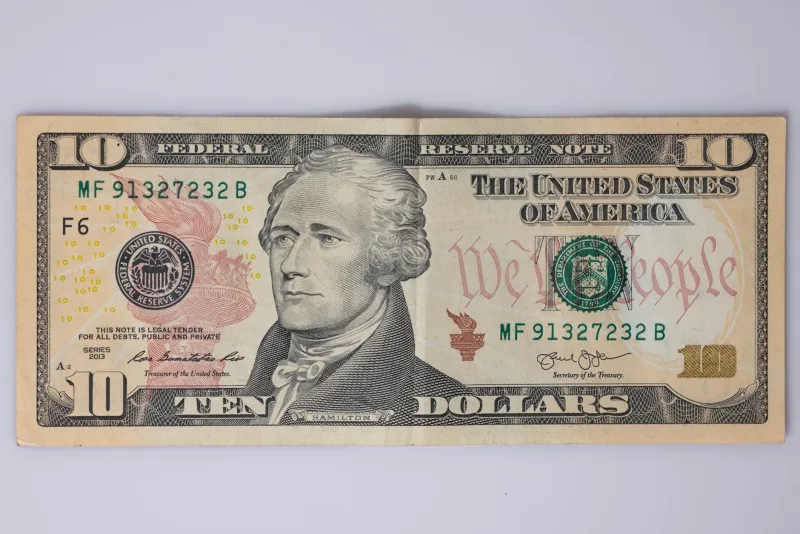
In 1862, the U.S. Treasury began printing the first "greenbacks" — Legal Tender Notes with distinctive green backs that were nearly counterfeit-proof. The front of the bills remained black, but the green reverse side made them instantly recognizable and incredibly difficult to reproduce.
The psychological impact was immediate. Americans had never seen government currency that looked quite like this before. The vibrant green backs became a symbol of official authenticity — if a bill had that distinctive color, you could trust it was real.
The term "greenback" entered American vocabulary almost overnight. Newspapers started using it to refer to the new currency, and within a few years, it had become the standard slang for paper money. Even today, more than 150 years later, Americans still call their dollars "greenbacks" because of a German chemist's failed wallpaper experiment.
The Science Behind the Security
What made this particular green so special wasn't just its photographic properties — it was also incredibly difficult to replicate chemically. The specific aniline compound required precise laboratory conditions and expensive materials that most counterfeiters couldn't access. Even if forgers could figure out the exact formula, producing the dye in large quantities required industrial equipment that was beyond the reach of criminal operations.
The Treasury Department kept the exact composition of their green dye a closely guarded secret. They worked with a select few chemical companies to produce the ink, and even those manufacturers only knew their specific part of the process. This compartmentalized approach meant that no single person outside the government knew how to recreate the complete formula.
Legacy of an Accidental Discovery
Today, American currency still bears traces of Griess's accidental discovery. While modern security features have evolved far beyond simple color-based protection, that distinctive green remains part of the dollar's visual identity. The Bureau of Engraving and Printing continues to use specialized inks and papers that make counterfeiting extremely difficult, but the psychological association between green and legitimate American money traces directly back to a 19th-century chemistry mistake.
The story of the greenback perfectly captures how accidental discoveries can reshape entire systems. Griess was trying to make wallpaper more beautiful — instead, he accidentally solved one of America's most pressing economic problems. His "failed" experiment didn't just change the color of money; it helped establish trust in paper currency at a crucial moment in American history.
Next time you handle a dollar bill, remember that its distinctive color exists because a German chemist couldn't figure out how to make decent wallpaper dye. Sometimes the most important discoveries are the ones nobody was looking for.