One Misread Sketch Changed How Eight Billion People Say 'I Agree'
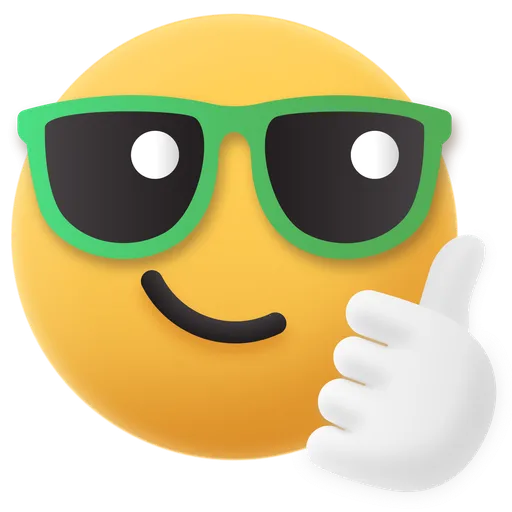
Photo: Bogdan Rosu, CC BY 4.0, via Wikimedia Commons
Every single day, billions of people tap a small yellow hand pointing its thumb skyward and consider the matter settled. A question answered. A plan confirmed. A photo appreciated. The thumbs-up emoji has become the default unit of digital agreement — the shortest possible sentence in the language of the internet.
But here's the thing almost nobody knows: that symbol, in the form we recognize it today, came from a mistake. A very specific, very consequential mistake made in a conference room full of engineers who had no idea they were about to define the visual vocabulary of human communication for generations.
The Committee Nobody Had Heard Of
In the late 1980s and early 1990s, a group of engineers, linguists, and software developers were wrestling with one of the more unglamorous problems in computing history: how do you get every computer on earth to display the same characters?
Different systems were using different encoding standards, which meant text written on one machine frequently turned into gibberish on another. The Unicode Consortium formed to solve this. Their job was to catalog every symbol, letter, and character used across every human language and assign each one a universal code. It was painstaking, thankless, and absolutely critical work.
To fill out the emoji section — a relatively minor part of the broader effort — the consortium turned to a set of character proposals that had been developed primarily in Japan, where emoji had already become a staple of mobile communication. Japanese designer Shigetaka Kurita had created an early set of 176 pictograms for NTT DoCoMo's mobile internet service back in 1999. These were tiny, 12-by-12-pixel images built for small screens and slow networks. They were never meant to travel.
The Sketch That Started Everything
When those original designs were submitted for international standardization, they had to be redrawn and interpreted by committee members working across language barriers and time zones. Kurita's original thumbs-up image — a compact, somewhat ambiguous little figure — went through several rounds of reinterpretation before it landed in the Unicode standard.
According to researchers who've traced the emoji's development path, the confusion centered on orientation and context. In Kurita's original sketches, the gesture was drawn in a style consistent with Japanese visual shorthand, where the thumb-up had a softer, more neutral connotation — something closer to "okay" or "noted" than the emphatic Western endorsement it implies.
During the translation process, American and European contributors on the standards committee read it through their own cultural lens. To them, a raised thumb meant approval, celebration, strong agreement. The symbol got coded into Unicode with that meaning baked in — and when Apple and Google began building their emoji keyboards in the late 2000s, they designed their versions to match that interpretation. Bold. Yellow. Enthusiastically upward.
The Global Rollout of a Culturally Loaded Symbol
What nobody in that standards committee fully accounted for was how differently a raised thumb reads around the world.
In the United States, thumbs-up means yes, good, approved. In parts of West Africa and the Middle East, it carries an obscene meaning roughly equivalent to a middle finger. In Greece and Sardinia, it historically signaled contempt. In Australia, it can read as aggressive depending on the motion. In Bangladesh, it's an insult.
And yet one standardized version — the cheerful, cartoonish, unambiguously enthusiastic yellow thumb — became the global default. Not because anyone decided it should be universal, but because Unicode locked it in, Apple and Google shipped it, and two billion smartphones put it in everyone's pocket before the cultural conversation had a chance to catch up.
By 2015, Facebook had introduced its Like button reaction set, and the thumbs-up was the centerpiece. By 2020, it was the most-used emoji on the platform. By 2023, it had become so ubiquitous in workplace messaging apps like Slack and Teams that a generational debate erupted — with younger workers reporting that receiving a thumbs-up from a manager felt passive-aggressive or dismissive rather than positive.
That's a remarkable amount of cultural weight for a symbol that exists because a committee in the early 1990s misread a sketch.
When a Symbol Outgrows Its Origin
Kurita himself has spoken in interviews about the strange experience of watching his original 176 characters evolve into something he barely recognizes. The emoji that now populate every smartphone keyboard are smoother, more detailed, more expressive — and in many cases, more culturally loaded — than anything he had in mind when he was designing tiny icons for a Japanese pager network.
The thumbs-up in particular has taken on a life so independent of its origins that it now means genuinely different things to different people even within the same country, the same office, the same text thread. A 55-year-old boss and a 24-year-old employee can send each other the exact same symbol and walk away with completely opposite impressions of what just happened.
That's not a design failure. It's something stranger — a symbol that was accidentally built for ambiguity and then handed to eight billion people who each decided what it meant.
The Emoji That Didn't Mean What Anyone Thought
The thumbs-up emoji is now one of the most recognizable images on earth. It appears in corporate communications, political campaigns, birthday messages, and passive-aggressive workplace replies. It has been analyzed by linguists, debated by HR departments, and banned in certain professional contexts.
None of that was planned. It happened because a Japanese designer's sketch got reinterpreted by a committee, a cultural assumption got embedded in a technical standard, and a phone company decided to ship it as the default button for saying yes.
The next time you tap that little yellow thumb and consider the matter closed, it's worth knowing: the symbol you just used to mean "agreed" has a more complicated history than almost anything else on your screen. And it only got there because, at a critical moment, nobody in the room was quite sure what they were looking at.