How a Renaissance Bean Counter's Shorthand Ended Up Inside Every Email Address on Earth
You've typed it thousands of times. It's in your email address, your social media handles, probably your login credentials for a dozen different services. The @ symbol is so fundamental to digital communication that it's hard to imagine the internet without it.
But for most of its existence, @ had nothing to do with communication at all. It was an accounting mark — a piece of medieval commercial shorthand used to measure quantities of goods. The fact that it ended up at the center of the digital revolution is the result of a chain of small, mostly accidental decisions that stretched across five centuries.
The Venetian Origins
The earliest confirmed appearance of the @ symbol in recorded history shows up in a 1536 letter written by a Florentine merchant named Francesco Lapi. Writing from Seville, Lapi used the symbol to denote amphorae — a unit of measurement for large clay jars used to transport wine and grain.
But the symbol's roots likely go back even further, into the monasteries of medieval Europe. Monks copying manuscripts are believed to have developed @ as a ligature — a merged shorthand — for the Latin word ad, meaning "at" or "toward." Over time, the symbol migrated from religious texts into commercial bookkeeping, where it found its true home.
By the height of the Renaissance, merchants across Italy were using @ to indicate unit prices in trade records. A ledger might read "10 jars @ 5 ducats each" — meaning ten units at five ducats apiece. The symbol was efficient, clear, and universally understood among traders across the Mediterranean. It was the commercial language of the era.
As European trade networks expanded, @ traveled with them. Spanish and Portuguese merchants carried it into their colonial accounting systems. English traders adopted it for commodity pricing. By the time the Industrial Revolution arrived, @ was a fixture in commercial correspondence across the Western world.
From Ledgers to Keyboards
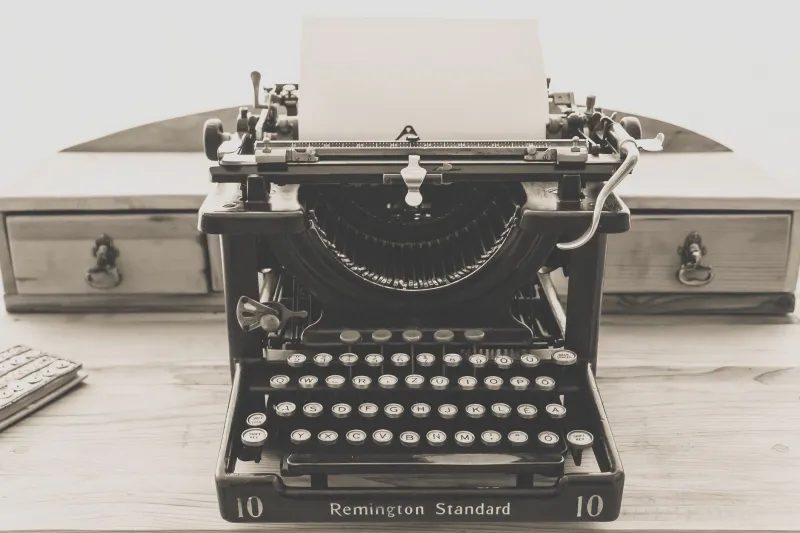
When the first commercial typewriters appeared in the 1870s, their designers faced a practical question: which symbols were essential enough to earn a dedicated key? The answer was shaped almost entirely by the needs of business correspondence.
The @ symbol made the cut. It had been a staple of invoices, purchase orders, and trade documents for centuries. Any typewriter intended for commercial use needed it. So it was assigned a key — typically somewhere on the top row — and it stayed there as keyboard designs evolved through the early twentieth century.
For decades, @ sat quietly on typewriter keyboards and, later, on the keyboards of early computer terminals. It was used occasionally in technical documentation and programming contexts, but it remained fundamentally a commercial relic — familiar but not particularly important.
Then, in 1971, a programmer named Ray Tomlinson changed everything.
The Decision That Defined the Internet
Tomlinson was an engineer working for the defense contractor BBN Technologies, helping to develop ARPANET — the early military network that would eventually evolve into the internet. He was working on a system to send messages between different computers on the network, and he faced a specific technical problem: how do you separate a person's name from the name of the machine they're using?
He needed a dividing character. Something that would clearly split "user" from "computer" without creating confusion in the existing code. The character had to be one that wouldn't appear in a person's name or a machine's address on its own.
Tomlinson scanned the keyboard. He later described the decision as taking only a moment. The @ symbol was perfect — it was already semantically associated with location ("at") in commercial English, it was unlikely to appear in anyone's name, and it was right there on the keyboard, unused and available.
He chose it almost on instinct. The first email address, sent to himself in a test message, read something like tomlinson@bbn-tenexa. He later admitted he couldn't remember what the message said. The punctuation mark he used to send it, though, has been replicated in every email address written since.
A Symbol the World Had to Rename
One of the stranger side effects of @'s digital takeover is what happened to its name. In American English, it was always simply called "the at sign." But as email spread globally in the 1990s, languages that had no common name for the symbol scrambled to invent one.
The results were wonderfully creative. In German, it became Klammeraffe — "spider monkey." In Russian, sobaka — "dog." Italians called it chiocciola, meaning "snail." In Danish, it's snabel-a, or "elephant trunk A." The Finns went with miukumauku, which roughly translates to "meow sign." Each culture looked at the same curling shape and saw something completely different.
In 2004, the Museum of Modern Art in New York added @ to its permanent collection — not a physical object, but the symbol itself, acknowledged as a landmark of modern design. The curator described it as a case study in how a simple mark can carry enormous meaning through pure cultural adoption.
Five Centuries of Reinvention
What makes the @ story remarkable isn't just the distance it traveled — from Venetian grain shipments to global digital infrastructure — but how little anyone planned any of it.
A medieval monk needed a shorthand for a Latin preposition. Renaissance merchants needed a quick way to write unit prices. Typewriter manufacturers needed to serve business customers. Ray Tomlinson needed a character that was already on the keyboard. Each step was practical, even mundane. Nobody was designing a symbol for the ages.
And yet here it is, embedded in the fabric of how billions of people communicate every single day. The next time you type your email address, you're completing a five-hundred-year-old sentence that started in a Florentine merchant's ledger — and ended up connecting the entire world.