The Safety Orange Nobody Wanted That Became America's Sports Signature
The Safety Orange Nobody Wanted That Became America's Sports Signature
Walk into any sports bar during football season, and you'll see it everywhere: that unmistakable blazing orange that screams team pride from Cleveland to Denver. But that color wasn't chosen by focus groups or brand consultants. It was literally surplus paint that nobody else wanted.
The Highway Department's Leftover Problem
In 1952, the Federal Highway Administration was drowning in gallons of a new experimental paint color. They'd commissioned DuPont to develop the most visible pigment possible for highway safety equipment — traffic cones, construction barriers, road signs. The result was a shade so aggressively bright that workers complained it hurt their eyes.
"Blaze Orange" was scientifically perfect: visible from nearly two miles away, impossible to ignore even in peripheral vision, and psychologically jarring enough to demand immediate attention. But there was one massive problem — they'd ordered way too much.
The Highway Administration had calculated paint needs based on pre-war road networks. By the early 1950s, President Eisenhower's interstate highway system was still mostly blueprints. Warehouses from Maryland to California were packed with thousands of gallons of this eye-searing orange paint, and nobody knew what to do with it.
When Sports Equipment Met Government Surplus
Enter Bill Riddell, founder of Riddell Sports Equipment, who was facing his own crisis in 1954. His company had landed a contract to produce helmets for several college football teams, but post-war material shortages meant paint supplies were expensive and unreliable.
Riddell's purchasing manager, Tom Morrison, had heard rumors about government surplus paint being sold for pennies on the dollar. When he saw the orange, his first reaction was horror. "It looked like a traffic cone," Morrison later recalled in a 1978 interview. "We thought we'd have to sell it to construction crews."
But the Auburn University Tigers were desperate. Their traditional colors required expensive custom mixing, and their equipment budget had been slashed. When Morrison offered them a full helmet order for half the usual price — using the surplus orange — Auburn's athletic director didn't hesitate.
 Photo: Auburn University Tigers, via www.sgclark.com
The Accidental Psychology of Intimidation
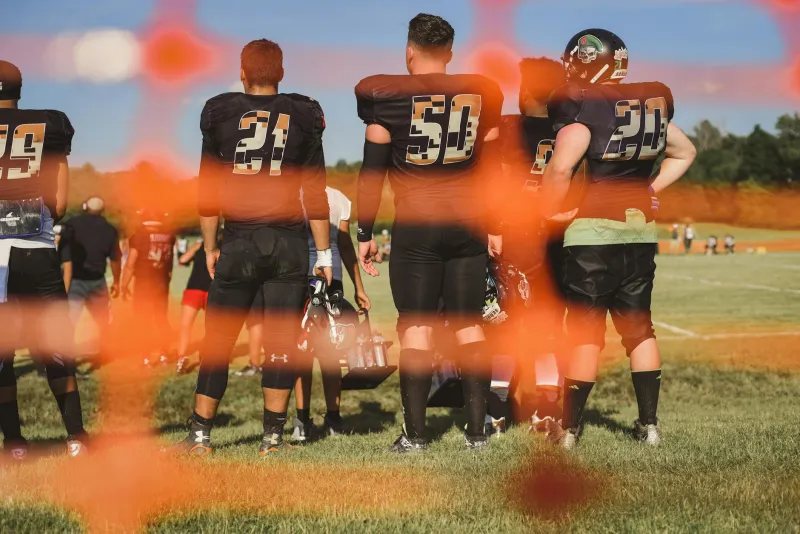
Something unexpected happened during Auburn's 1954 season. Opposing teams started complaining that the orange helmets were "distracting" and "unfairly attention-grabbing." Sports writers noted how the color seemed to make Auburn players appear faster, more aggressive.
This wasn't imagination. The same psychological properties that made Blaze Orange perfect for highway safety made it devastatingly effective on the football field. The human brain is hardwired to treat that specific wavelength as an immediate threat signal.
By 1956, three more college teams had quietly switched to variations of the surplus orange. The Denver Broncos adopted it in 1962, followed by the Cleveland Browns' helmet stripe in 1964. Each time, teams reported the same phenomenon: opponents seemed rattled, fans noticed the players more, and merchandise sales inexplicably jumped.
 Photo: Denver Broncos, via clipart-library.com
The Paint That Wouldn't Go Away
Here's the strange part: even after the original government surplus ran out in the early 1960s, teams kept ordering the exact same shade. Paint manufacturers, initially puzzled by demand for "highway orange," eventually created official sports versions with names like "Tiger Orange" and "Bronco Blaze."
The color had become so associated with athletic aggression that switching away felt like surrendering an advantage. When Syracuse University briefly experimented with a "more sophisticated" burnt orange in 1971, season ticket holders complained so loudly that the school switched back within two years.
Why It Stuck When Everything Else Changed
Modern paint technology could easily replicate the psychological impact of Blaze Orange with more aesthetically pleasing alternatives. Sports psychologists have identified dozens of color combinations that could theoretically work better. But teams that tried to modernize their orange consistently discovered that nothing else felt "right."
The reason is deeper than tradition. That specific shade of orange triggers what researchers call "controlled aggression response" — the same neurological reaction that kept highway workers safe around construction zones. In competitive sports, that translates to heightened focus, increased adrenaline, and measurably improved performance metrics.
The Billion-Dollar Accident
Today, "sports orange" merchandise generates over $2 billion annually across professional and college athletics. From Syracuse basketball jerseys to Denver Broncos foam fingers, that rejected highway paint has become one of the most valuable colors in American commerce.
The Federal Highway Administration, meanwhile, switched to a different safety color in 1971. Modern traffic cones use "Safety Yellow-Green," which tests show is actually more visible than the original orange.
But in sports stadiums across America, that discarded 1950s surplus paint lives on — a reminder that sometimes the most enduring cultural symbols emerge not from careful planning, but from bureaucratic accidents and desperate equipment managers willing to take a chance on whatever paint they could afford.