How a Sleepy Rodent in Rural Pennsylvania Became America's Most Watched Weather Prophet
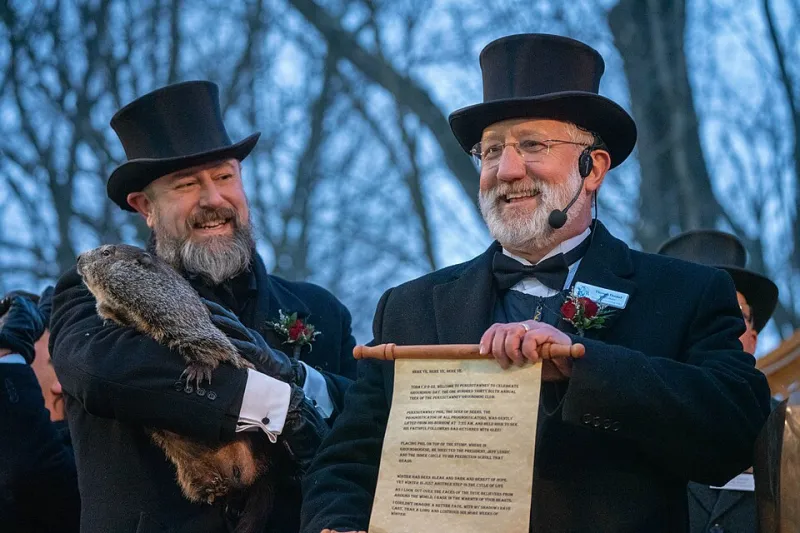
Photo: Anthony Quintano from Mount Laurel, United States, CC BY 2.0, via Wikimedia Commons
The Animal Nobody Thought Would Last
Every February 2nd, television crews descend on a small Pennsylvania town before dawn. Crowds gather in freezing temperatures. A man in a top hat reaches into a wooden hutch and pulls out a large rodent. The nation watches. It sounds like something a bored local chamber of commerce dreamed up on a slow afternoon — and honestly, that's not far from the truth.
But the full story of Groundhog Day runs much deeper than a quirky tourism stunt. It stretches back centuries, crosses an ocean, and winds through the specific anxieties of immigrant communities trying to hold onto the only forecasting tools they'd ever trusted.
It Didn't Start With a Groundhog
The tradition that eventually landed in Pennsylvania didn't begin there — or with a groundhog. In Germany and the broader Germanic cultural world, February 2nd held a specific place in the folk calendar. It fell at the midpoint between the winter solstice and the spring equinox, a moment when farmers desperately needed to know whether winter had more fight left in it.
The animal at the center of the original superstition was the badger. According to German and Swiss folk belief, if a hibernating badger emerged on that day and saw its shadow — meaning the sun was out and skies were clear — it would retreat underground, signaling six more weeks of harsh weather. A cloudy day, paradoxically, meant early spring. The logic, such as it was, held that bright winter sunshine indicated a cold, stable high-pressure system that would stick around, while overcast skies suggested warmer, shifting weather was already moving in.
When German immigrants — often called the Pennsylvania Dutch — settled in central Pennsylvania in the 18th and 19th centuries, they brought this tradition with them. The problem was the American landscape didn't have many badgers in that region. It did, however, have groundhogs. Close enough.
The Newspaper That Made It Official
For decades, the tradition existed quietly in small farming communities, passed between neighbors and generations without much fanfare. That changed in 1887, when a local newspaper editor named Clymer Freas at the Punxsutawney Spirit decided to write about the local groundhog-watching custom in a way that framed it as an official annual event.
Freas was a founding member of a hunting and social club called the Punxsutawney Groundhog Club, and the group had been making informal excursions into the woods outside town to observe a groundhog they'd named Punxsutawney Phil. Freas published a notice declaring Phil the only true weather-forecasting groundhog in America — a playful, self-aware piece of local boosterism that nonetheless gave the tradition a fixed name, a fixed location, and a fixed date.
 Photo: Punxsutawney Phil, via www.exoticshunter.com
The naming mattered enormously. Once Phil had an identity, the event had a character. And once it had a character, it had a story worth telling year after year.
From Local Quirk to National Spectacle
For most of the 20th century, Groundhog Day remained a charming regional oddity — covered by wire services, noted in newspapers, but not exactly appointment viewing. That changed in stages as television spread the visual spectacle of the event to audiences who'd never heard of Punxsutawney.
The images were simply irresistible: men in formal coats and silk hats, a crowd bundled against February cold, and a bewildered animal being hoisted into the air. Local news stations began sending crews. National networks picked it up. By the 1980s, February 2nd had become a reliable fixture in the American news cycle — one of those stories that runs every year because it has always run every year.
Then came 1993. Harold Ramis's film Groundhog Day, starring Bill Murray as a cynical weatherman trapped in a time loop in Punxsutawney, didn't just celebrate the tradition — it embedded it permanently into American pop culture. The movie gave the holiday a metaphorical weight it had never carried before, and attendance at the annual event in Pennsylvania surged. The town that had been a curiosity became a destination.
 Photo: Harold Ramis, via m.media-amazon.com
What Science Actually Says
Here's where things get genuinely interesting. Multiple analyses of Phil's predictions over the decades have found his accuracy rate hovering somewhere around 40 percent — which is, statistically speaking, worse than a coin flip. The National Oceanic and Atmospheric Administration has gently but clearly noted that there is no scientific basis for the shadow forecast.
And yet the tradition not only survives — it thrives. Tens of thousands of people still travel to Punxsutawney each year. Dozens of other towns across North America have launched their own competing groundhog ceremonies, complete with their own named animals and local mythology.
The reason isn't that Americans distrust meteorologists. It's that Groundhog Day was never really about the weather. It was about community, ritual, and the distinctly human need to mark the passage of winter with something that feels like hope. The Pennsylvania Dutch farmers who first adapted the badger tradition to their new home weren't foolish — they were doing what people have always done: creating a shared moment to get through the hardest part of the year together.
Why It Still Matters
Groundhog Day is a perfect case study in how folk traditions survive not because they work, but because they mean something. The German superstition crossed an ocean, lost its original animal, got adopted by a small-town newspaper editor with a flair for promotion, and eventually got turned into a Bill Murray movie. At every step, someone found a reason to keep it going.
The next time you see Phil hoisted into the morning air on your phone screen or television, remember: you're watching a centuries-old immigrant tradition that survived precisely because nobody ever took it too seriously — and everyone took it just seriously enough.