The Identity Crisis That Put a Star on Every Cop's Chest
The Identity Crisis That Put a Star on Every Cop's Chest
In the chaotic aftermath of the Civil War, American frontier towns faced a problem that threatened the very concept of law and order: nobody could tell who was actually authorized to enforce the law. Self-appointed sheriffs, confidence men posing as federal marshals, and vigilante groups all carried weapons and claimed authority to make arrests. The solution came from an unlikely source—the same metalworking techniques used to make belt buckles and harness fittings.
 Photo: Civil War, via orgel-verzeichnis.de
That simple piece of stamped metal would become the most recognizable symbol of legitimate authority in American history, pinned to the chests of everyone from small-town sheriffs to FBI agents.
The Post-War Authority Vacuum
The end of the Civil War in 1865 created an unprecedented law enforcement crisis across the expanding American frontier. Established legal systems had collapsed in many regions, federal authority was stretched thin, and thousands of discharged soldiers—from both armies—had scattered across territories where formal government barely existed.
Into this vacuum stepped anyone willing to claim authority. Former Confederate soldiers appointed themselves sheriffs in towns that had never officially incorporated. Union veterans declared themselves federal marshals in territories that had never seen a federal officer. Confidence men discovered that a stern voice and a visible weapon could convince desperate townspeople to accept their authority.
The problem wasn't just fraud—it was deadly confusion. When multiple people claimed to be the legitimate sheriff of the same territory, confrontations inevitably turned violent. Towns found themselves caught between competing authorities, never sure which orders to follow or which arrests were legal.
The Railroad's Solution
The first systematic solution came from an unexpected source: railroad companies. As they pushed tracks across the frontier, railroad executives realized they needed a way to identify their own security personnel and distinguish them from the various imposters and vigilantes who plagued construction camps.
Railroad police began wearing distinctive metal badges—simple stamped pieces that bore the company name and the word "Police." The badges served a dual purpose: they identified legitimate authority to workers and townspeople, and they were expensive enough to produce that casual imposters couldn't easily replicate them.
The railroad model proved so effective that established law enforcement agencies began adopting similar identification systems. But the early badges were purely functional—simple rectangles or circles with basic text, designed for identification rather than authority projection.
The Star's Symbolic Power
The transformation from simple identification to powerful symbol began with the adoption of the star shape. Unlike geometric forms, the star carried deep cultural resonance in American society. It appeared on the flag, represented the states in the Union, and had been used as a symbol of guidance and authority since ancient times.
More practically, the star's multiple points made it nearly impossible to mistake for civilian jewelry or military insignia. When stamped in metal and worn on a chest, the star created an unmistakable silhouette that could be recognized from a distance—crucial in an era when quick identification could mean the difference between cooperation and confrontation.
The five-pointed star became the standard not through federal mandate, but through practical adoption. Sheriffs who wore star-shaped badges found that their authority was more readily accepted by both townspeople and troublemakers. The shape itself seemed to communicate legitimacy in a way that words alone couldn't achieve.
The Technology of Trust
Early police badges were marvels of 19th-century metalworking technology. Craftsmen used dies and presses to create raised designs that were nearly impossible to counterfeit with available tools. The badges often incorporated intricate details—scrollwork, municipal seals, and carefully rendered text—that required specialized equipment to reproduce.
This technological barrier was crucial to the badge's effectiveness. A genuine badge represented a significant investment by a legitimate government entity, while a fake badge would obviously lack the precision and detail of professional metalwork. The physical properties of the badge itself became a form of authentication.
The standardization of badge-making also created an informal network of legitimate law enforcement. Sheriffs and marshals could examine each other's badges and immediately assess their authenticity based on craftsmanship, materials, and design consistency. This peer recognition system helped establish trust between law enforcement agencies across vast territories.
Federal Adoption and Standardization
The success of local badge systems caught the attention of federal law enforcement agencies. The U.S. Marshals Service, established in 1789 but lacking consistent identification, adopted standardized badges in the 1870s. Federal agents discovered that a recognizable badge could open doors and establish authority more effectively than any written credentials.
 Photo: U.S. Marshals Service, via www.pngplay.com
The Secret Service, founded in 1865, initially operated without distinctive badges, relying instead on written commissions that few people could verify. By the 1880s, they had adopted a badge system that allowed agents to establish their identity instantly, even in remote locations where federal authority was rarely seen.
 Photo: Secret Service, via www.cams.reviews
This federal adoption created a hierarchy of badge designs that persists today. Local law enforcement typically wore five-pointed stars, state agencies adopted six-pointed stars or shields, and federal agencies developed distinctive designs that clearly indicated national authority.
The Psychology of the Badge
Modern research has revealed why the police badge became such a powerful symbol of authority. The human brain processes star shapes faster than most geometric forms, creating an immediate recognition response. The metallic shine of a badge catches light and draws attention, while the chest placement positions it at the center of interpersonal interaction.
More importantly, the badge creates what psychologists call "symbolic authority"—the transfer of institutional power to an individual through a visible token. The same psychological mechanism that makes crowns represent royal authority or military stripes represent rank makes the police badge an instant indicator of law enforcement power.
This psychological effect extends beyond the person wearing the badge. Studies show that people respond differently to someone wearing a visible badge even when they're not consciously aware of it. The badge triggers automatic respect and compliance responses that help law enforcement officers maintain order with minimal confrontation.
The Modern Legacy
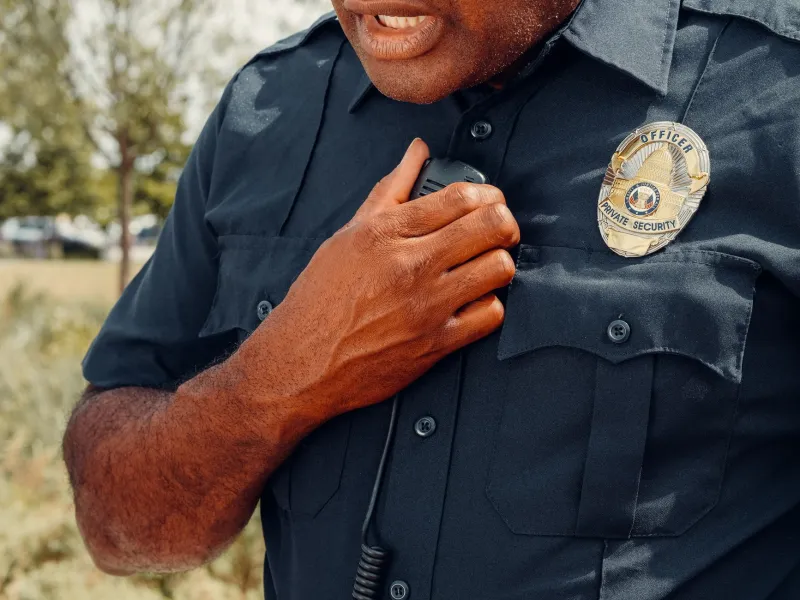
Today, virtually every law enforcement officer in America wears some form of badge, from local police to federal agents. The basic design principles established in the post-Civil War era—distinctive shape, quality metalwork, official authorization—remain unchanged despite advances in technology and materials.
Modern badges incorporate anti-counterfeiting features that would amaze 19th-century sheriffs: holographic elements, special alloys, and microscopic details. But the fundamental purpose remains identical: instantly identifying legitimate authority in a world where anyone might claim to be a law enforcement officer.
The police badge represents one of the most successful solutions to an identity crisis in American history. A simple piece of stamped metal solved the problem of distinguishing legitimate law enforcement from imposters, vigilantes, and con artists. In doing so, it created a symbol that now represents the concept of lawful authority itself.
Every time a police officer pins on a badge, they're participating in a tradition that began with desperate frontier towns trying to figure out who they could trust with a gun and the power to make arrests. The star on their chest carries the weight of that history—and the responsibility that comes with being the person others look to when order breaks down.