Your Bathroom Cabinet Has a Darker Past Than You Think
Every morning, millions of Americans swing open a small mirrored cabinet above the bathroom sink, grab what they need, and close it again without a second thought. It's such an ordinary fixture that most people couldn't tell you when it appeared in their home, let alone why it exists in the first place. But the medicine cabinet has a history that's considerably darker than its clean white shelves suggest — one that begins not with health and hygiene, but with poison.
Victorian Homes Were Surprisingly Dangerous Places
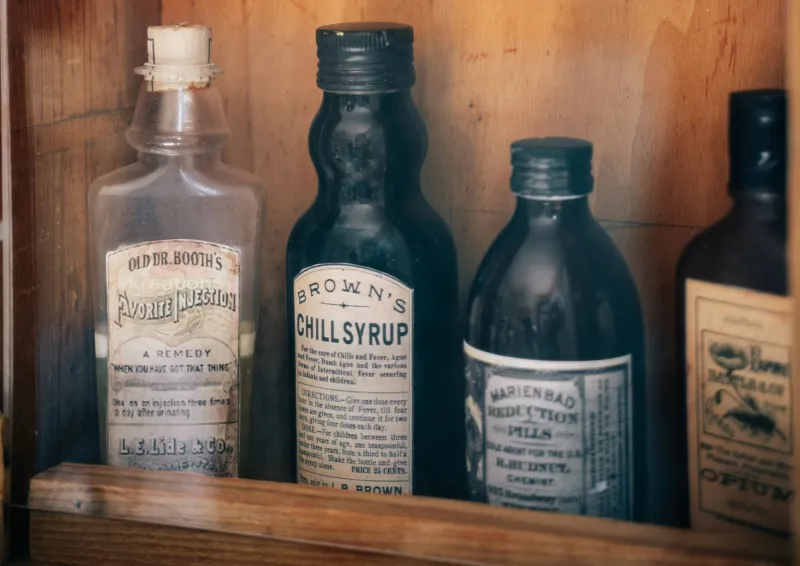
By the mid-1800s, the average American household contained an alarming number of toxic substances, and most of them were considered completely normal. Arsenic was used in green wallpaper dyes and fabric colorings. Mercury was a standard ingredient in teething powders given to infants. Laudanum — a liquid mixture of opium and alcohol — was sold over the counter and kept in kitchen cupboards as a general-purpose painkiller, sleep aid, and cough suppressant. Rat poison sat on pantry shelves beside the flour.
This wasn't negligence. It was just the reality of 19th-century domestic life, where the line between medicine and poison was blurry at best, and where household chemical knowledge was patchy and inconsistent. Accidental poisonings were common enough that they became a genuine social concern, particularly in wealthier households with large domestic staffs.
The problem, from a Victorian perspective, wasn't just children getting into dangerous substances — it was also the question of servant access. Middle- and upper-class households worried about servants stealing laudanum or, in darker imaginings, using household poisons with more deliberate intent. Locking up dangerous substances became a matter of both safety and class anxiety.
The Locked Box That Started It All
The earliest ancestor of the modern medicine cabinet was exactly that: a lockable wooden box, typically mounted on a wall or stored in a bedroom, that kept the household's medicines and toxic substances secured. These weren't bathroom fixtures — bathrooms as we know them barely existed in most American homes before the late 19th century. The box lived wherever the household's most valuable and dangerous items were stored, often near the master bedroom or in the housekeeper's domain.
Pharmacies reinforced this culture of caution. Victorian druggists were well aware that their products could kill as easily as cure, and many proactively sold their wares in distinctively shaped or colored bottles — cobalt blue glass, ribbed surfaces, bottles with unusual stoppers — so that even in the dark, a person reaching for medicine could tell by touch whether they had the right container. The idea was to build safeguards into the physical object itself.
As the 19th century wound toward its close, public health advocates began pushing for more systematic approaches to household chemical safety. Poison registries, warning labels, and standardized packaging all became part of a broader conversation about who was responsible for keeping dangerous substances out of the wrong hands.
The Bathroom Gets Its Own Room — and Its Own Cabinet
The real turning point came with the rapid expansion of indoor plumbing in American homes during the 1880s and 1890s. As dedicated bathroom spaces became standard in middle-class construction, designers and architects began thinking about what those rooms needed to contain. The bathroom was evolving from a purely functional space into something more personal — a private room associated with hygiene, health, and daily ritual.
It made intuitive sense to move medicine storage into this new space. The bathroom was already where people managed their bodies. It had running water for taking pills or cleaning wounds. And critically, it was a room that could be locked — giving it some of the same security function as the old household poison box.
Early built-in medicine cabinets began appearing in American homes around the turn of the 20th century, typically as a recessed wooden box with a simple door. The mirrored front came shortly after, driven partly by practicality (the bathroom needed a mirror anyway) and partly by the emerging bathroom fixture industry's interest in selling homeowners a unified, elegant look. By the 1920s and 1930s, the mirrored medicine cabinet had become a standard feature in American bathroom design, appearing in catalogs from Sears and in the specifications of new suburban construction.
The Pharmaceutical Revolution Changed What Went Inside
As the cabinet became standard, what Americans stored in it shifted dramatically. The early 20th century brought a wave of pharmaceutical regulation — the Pure Food and Drug Act of 1906, followed by tighter controls through the 1930s — that slowly cleared the most dangerous substances from everyday household use. Arsenic-laced products disappeared. Laudanum became a controlled substance. The casual availability of opiates that had defined Victorian medicine was curtailed.
In their place came a new generation of branded, regulated, over-the-counter products: aspirin (introduced to American consumers in 1899), iodine antiseptics, petroleum jelly, and eventually the antibiotic ointments and antihistamines that stock most medicine cabinets today. The cabinet's contents transformed from a locked collection of genuinely lethal substances into a relatively benign assortment of everyday health products.
The lock disappeared too. As the contents became safer and as the cultural anxiety around servant access faded, the medicine cabinet became an open fixture — something you'd swing casually open in front of a houseguest without a second thought.
A Fixture That Outlasted Its Reason for Existing
Today, the medicine cabinet sits in a slightly awkward position. Many health professionals point out that the bathroom is actually one of the worst places to store medication — heat and humidity from showers degrade pills and liquid medicines faster than a cool, dry location would. The cabinet's original logic, built around poison control and household security, has long since evaporated.
And yet there it is, above your sink, in virtually every American bathroom built in the last hundred years. A mirrored rectangle that began as a locked box for Victorian poison, evolved into a symbol of modern hygiene, and ended up as the place where most people keep their expired cough syrup and a half-empty bottle of ibuprofen.
The dangerous stuff is gone. The cabinet remains.