Why You Stare at the Elevator Door: The Manhattan Experiment That Wrote the Rules of Awkward
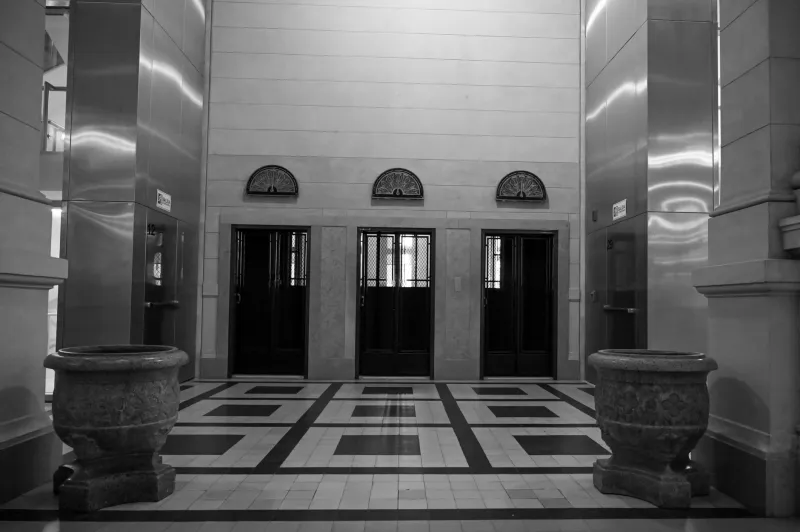
You've done it a thousand times. You step into an elevator, shuffle to a corner, face the door, and spend the next thirty seconds studying the floor numbers like they're the most fascinating thing you've ever seen. Nobody told you to do this. There's no posted sign. And yet, if someone gets in and faces the back wall — or worse, stares directly at you — something in your brain screams that a social law has just been broken.
Where did these unspoken rules come from? The answer leads back to a specific moment of collective anxiety in 1960s Manhattan, a psychologist with a clipboard, and a city that was quietly having a breakdown about personal space.
New York Was Getting Too Close for Comfort
By the early 1960s, Manhattan office buildings were getting taller, faster, and more crowded. The postwar economic boom had packed hundreds of thousands of workers into vertical towers, and suddenly Americans were spending large chunks of their day doing something that felt deeply unnatural: standing inches away from strangers in a metal box.
Environmental psychologist Robert Sommer was among the first researchers to take this discomfort seriously. Working at the intersection of architecture and human behavior, Sommer and his colleagues began studying what happened to people's bodies and minds when they were forced into close proximity with strangers. What they found wasn't pretty. Heart rates climbed. People tensed their muscles. They avoided eye contact with almost military precision.
Sommer's broader work on "personal space" — a term he helped popularize — established that Americans in particular maintained invisible bubbles of roughly eighteen inches to four feet around themselves in social situations. An elevator, obviously, made that bubble impossible to maintain. So the mind did the next best thing: it invented rituals to signal that the intrusion wasn't personal.
The Rituals That Saved Everyone's Sanity
Facing the door was the first and most powerful of these rituals. By turning away from other occupants, you communicated something essential without words: I see you, I acknowledge we're both trapped here, and I am deliberately not threatening you. It was, in a strange way, an act of social generosity.
The corner-claiming behavior followed a similar logic. Spreading passengers into the corners of an elevator maximized the distance between bodies and created a kind of geometric order that the brain found soothing. Studies from the era showed that people entered elevators and unconsciously redistributed themselves like magnets repelling each other — always seeking the maximum possible distance.
The downward gaze at phones (or, in earlier decades, at watches and newspapers) came slightly later, but it served the same function. It gave everyone permission to pretend the others didn't exist. Not out of rudeness, but out of mutual mercy.
Sommer documented these behaviors, and other researchers — including sociologist Erving Goffman, whose work on "civil inattention" explored how strangers politely ignore each other in public — gave them theoretical weight. By the late 1960s, behavioral scientists had essentially mapped out the unwritten constitution of elevator conduct.
How the Rules Went Mainstream
Here's the remarkable part: nobody published a pamphlet. Nobody ran a public awareness campaign. The rules spread entirely through imitation and social pressure, absorbed by millions of Americans who rode elevators daily and unconsciously mirrored what they saw.
Architects and building designers quietly took note. By the 1970s, elevator interiors were being redesigned with these anxieties in mind. Mirrored walls appeared — partly decorative, but also functional, since they allowed passengers to monitor others in the car without making direct eye contact. Handrails gave fidgety hands something to grip. The standard dimensions of elevator cabs became subtly calibrated to the findings of crowding research.
Office designers went further. The discomfort documented in elevator studies influenced how break rooms, hallways, and open-plan offices were conceived. If people needed rituals to survive thirty seconds in a box, what did that mean for eight hours in a shared workspace? The answer, eventually, was cubicles — private territory carved out of shared space, a permanent elevator corner you could call your own.
The Rules That Refused to Stay on the First Floor
What's striking is how thoroughly elevator logic colonized other parts of American life. The same civil inattention that governs elevator rides shows up in subway cars, waiting rooms, and airport gate areas. Americans have become remarkably skilled at being physically close to strangers while maintaining a practiced psychological distance.
Social media, oddly, operates on a similar principle. Millions of people occupy the same digital space — a comment section, a trending feed — and have developed their own rituals for signaling non-aggression. The casual scroll, the quick like, the deliberate non-engagement with someone else's post: these are elevator behaviors translated into the digital world. You're in the box with everyone else, and you're all staring at the door.
Violating elevator norms still triggers a visceral reaction, which tells you just how deeply these rules are embedded. Comedians and social experimenters have filmed themselves facing the back wall of elevators for decades, and the footage is always the same: other passengers shift, glance sideways, and radiate discomfort. The rules have no enforcement mechanism, and yet they hold.
The Panic Attack That Built a Social Code
It's worth pausing on what this all means. An entire layer of American social behavior — one that billions of people follow every single day without thinking — traces back to a specific moment of collective anxiety in a city that was building too fast and packing too many people into too small a space.
The researchers who studied it weren't trying to create etiquette. They were trying to understand distress. But in documenting how people coped with the discomfort of crowding, they inadvertently mapped a social grammar that then spread outward, shaping architecture, office design, and eventually the unwritten rules of digital life.
Next time you step into an elevator and automatically face the door, you're not just following a habit. You're participating in a behavioral tradition that started with a city on the edge of a collective panic attack — and quietly solved one of the most basic problems of modern life: how to be alone together.