The Shelf Space Crisis of 1932 That Invented the Way You Grocery Shop Today
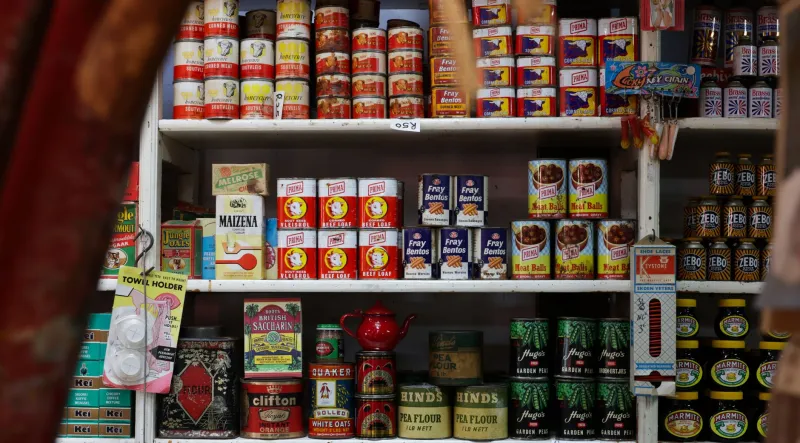
There's a specific moment that happens to almost everyone in a grocery store. You went in for milk and eggs. You're leaving with a box of cereal you didn't plan to buy, a granola bar you spotted at eye level, and maybe a bottle of something that caught your attention from across the aisle. You don't know exactly when the decision happened. It just did.
That experience — ubiquitous, profitable, and slightly embarrassing — wasn't designed by a psychologist or a marketing genius. It was the downstream consequence of a storekeeper in the 1930s who simply ran out of room.
How Grocery Stores Worked Before the Aisle
To understand what changed, you have to picture what American grocery shopping looked like before the supermarket era. Through most of the late 19th and early 20th centuries, the dominant model was the counter-service store. You walked in, told the clerk what you needed, and they retrieved it from shelves or storage behind the counter. You didn't browse. You requested.
The shift toward self-service retail began gaining momentum in the 1910s and 1920s, pioneered by chains like Piggly Wiggly, which opened the first true self-service grocery store in Memphis, Tennessee in 1916. Customers were now handed a basket and allowed to walk the store themselves, picking items directly from displays. It was a radical idea at the time — and a commercially successful one.
But early self-service stores still organized their inventory in relatively flat, horizontal arrangements. Products were laid out on low tables or shallow shelves, grouped loosely by type. The store was navigated more like a market than a modern supermarket. Displays were wide and low. Aisles were irregular. There was no particular logic to vertical space.
The Overflow Problem
By the early 1930s, chain grocery retailers were expanding aggressively, and the economics of the business were pushing toward higher volume and lower margins. Carrying more SKUs — more product varieties — was essential to competing. But floor space was expensive and finite.
The specific inflection point that food retail historians point to wasn't a single dramatic event, but a series of practical experiments happening across multiple growing chain stores during the Depression era. Retailers who couldn't afford to expand their footprints started asking a simple question: what's above the current shelving?
The answer, obviously, was empty air. And empty air was wasted real estate.
Stores began extending shelving units upward, stacking inventory in vertical columns that reached well above the previous display height. Products that had previously been stored in back rooms or basements were brought to the floor and arranged in tall, uniform columns. The aisle — defined by two facing walls of shelving running in a parallel line — emerged as the natural organizing structure for this new vertical format.
This wasn't a design philosophy. It was a logistics solution. Stack it up, run a lane between the stacks, let customers walk the lane. Simple.
What Vertical Shelving Did to Human Attention
Here's where the accident compounds into something much larger.
When products are arranged horizontally on low tables, a shopper's eye scans left to right across a limited selection. The browsing is selective and relatively controlled. But when products are arranged in tall vertical columns lining both sides of a narrow aisle, something different happens to human attention.
The shopper's field of vision is now surrounded by product on three sides — left wall, right wall, and the far end of the aisle. Movement through the aisle creates a continuous visual stream of packaging, color, and brand signage. Items at eye level dominate attention. Items lower down recede. Items higher up catch peripheral vision.
Retailers and consumer goods companies began noticing, with some excitement, that product placement within this vertical structure had a measurable effect on sales. Items positioned at eye level — roughly between waist and shoulder height — sold significantly faster than identical items placed at floor level or above reach. The aisle had inadvertently created a hierarchy of visibility, and that hierarchy was monetizable.
By the late 1930s and into the postwar boom of the 1940s and 50s, consumer packaged goods companies were paying for premium shelf placement. The practice of "slotting" — paying retailers for favorable shelf position — formalized what had started as a pure space-saving improvisation. Eye-level placement became a commercial transaction.
The Cereal Aisle as a Case Study
No product category illustrates this dynamic more vividly than breakfast cereal. The cereal aisle in a modern American supermarket is one of the most deliberately engineered retail environments in existence — a dense corridor of color, cartoon characters, and competing nutritional claims that can run 50 to 60 feet in a large store.
Cereals marketed to children are positioned at a lower eye level — specifically calibrated to the sight line of a child sitting in a shopping cart. Adult cereals occupy the mid-range. Premium and organic options often claim the upper shelves, playing to the consumer psychology that reaching slightly upward feels like a deliberate, considered choice.
None of this was in the original plan when someone first bolted a few extra shelving brackets to a wall in 1932. But every element of it flows from that original structural decision to go vertical.
The Impulse Economy
American consumers today make somewhere between 60 and 70 percent of their grocery purchasing decisions inside the store, according to retail industry research — not on a list prepared at home. A substantial portion of those in-store decisions happen in the aisle, driven by visual exposure to products the shopper wasn't specifically seeking.
That number represents hundreds of billions of dollars in annual sales. It supports an entire industry of retail design consultants, shelf-space analysts, packaging designers, and consumer behavior researchers. It shapes how food companies design labels, how supermarket chains negotiate with suppliers, and how store layouts are engineered to maximize the distance a shopper travels before reaching the item they actually came for.
All of it, in some traceable way, leads back to a store that needed more room and found it by looking up.
The aisle didn't come from a focus group or a retail strategy summit. It came from a space problem. And space problems, it turns out, have a way of restructuring the world around them.